An AI knowledge base
for your business
The IOWIS Platform makes internal documents and knowledge sources available for use with AI. Employees ask questions in natural language and receive answers based on selected company content.
Knowledge resources can be organised for different teams, tasks and assistants. In a fully on-premises deployment, language models and core processing run in your infrastructure, on hardware selected to suit your requirements.
IOWIS supplies the platform and hardware and supports the technical implementation.
Your company already has the knowledge,
but finding it can be difficult
Most companies already have policies, technical documentation, process descriptions, project documents and internal guides.
The challenge is finding the right information when it matters. Content is spread across repositories, business applications and documents. Employees need to know where to look, which terms were used and which document answers their specific question.
Traditional search tools often return files or individual results. Employees still have to work through the material to find the answer they need. Recurring questions therefore lead to the same people being asked or the same documents being searched again.
An AI knowledge base provides another way to access this information. Employees ask specific questions and receive an answer drawn from the company content connected to the platform.
How an AI knowledge base works
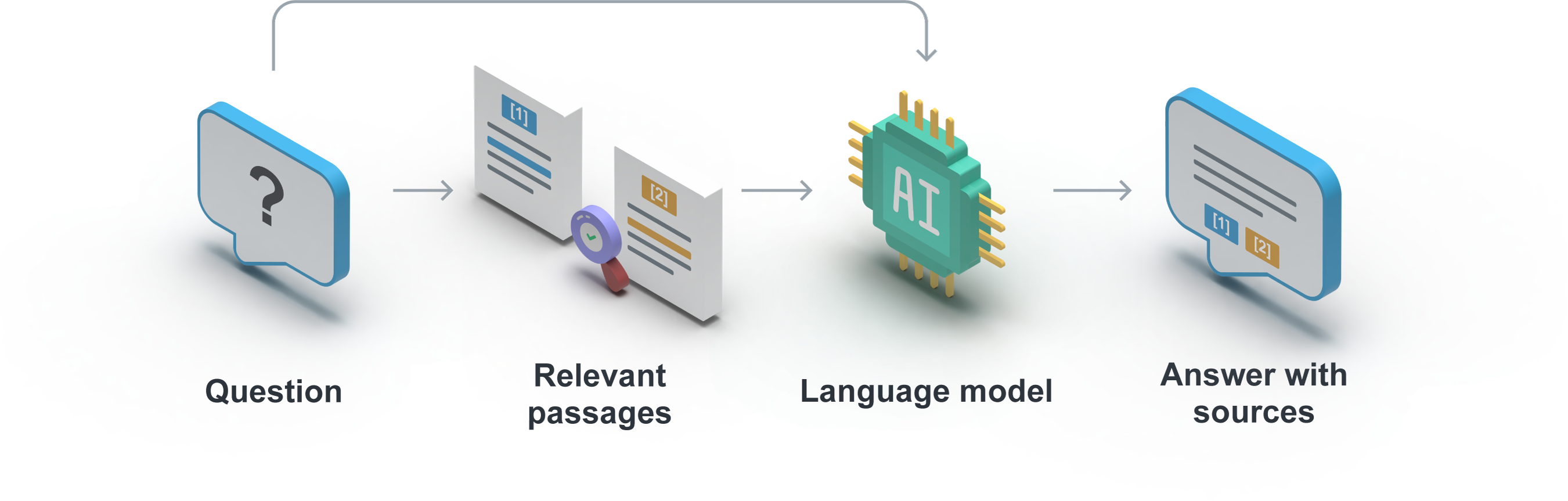
A conventional file repository stores and organises documents. An AI knowledge base also helps find relevant information within those documents and present it in response to a specific question.
Company documents do not become a permanent part of the language model.
Instead, when a request is made, the platform searches the connected knowledge sources for relevant passages. This selected content is supplied to the language model together with the question. The model uses it to produce a clear answer.
This process is called retrieval-augmented generation, or RAG. It combines a search for relevant company information with a language model’s ability to summarise that information and apply it to a specific question.
The answer shows which sources were used. Employees can see which documents support a statement and check the original content when needed.
Knowledge resources can be updated by adding, replacing or removing documents. There is no need to retrain the language model.
Assistants can also be configured to answer questions about internal information strictly on the basis of the connected sources. If those sources do not contain enough reliable information to answer the question, the assistant does not generate an answer.
We can help you build a knowledge base or improve an existing RAG system, even if you do not use the IOWIS Platform. Find out more about our services for company knowledge and RAG.
Connect documents and existing knowledge sources
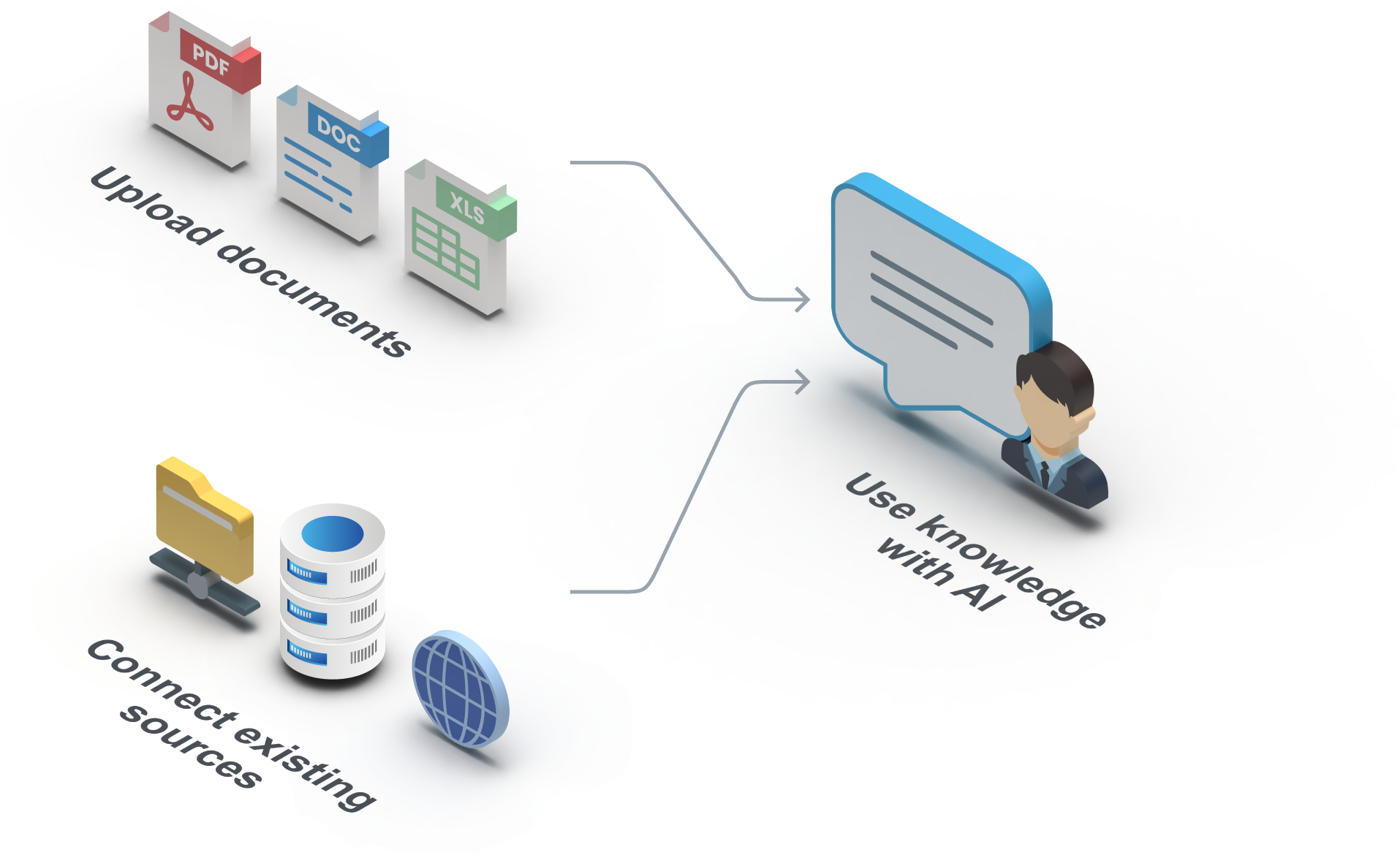
Documents can be uploaded directly to the IOWIS Platform, analysed and used for individual tasks. Knowledge bases are available for content that needs to remain accessible over time.
They can bring together:
- policies, procedures and process descriptions,
- technical documentation and manuals,
- product and service documentation,
- training and onboarding materials,
- project and quality documentation,
- organisational and HR documents.
Depending on the plan and technical integration, existing sources can also be connected. These include file repositories, SharePoint, FTP directories, internal business applications, websites and other systems with suitable interfaces.
Existing repositories and business applications do not necessarily need to be replaced. The use case determines which content is managed directly in the platform and which is accessed through existing systems.
Organise knowledge and access around your needs
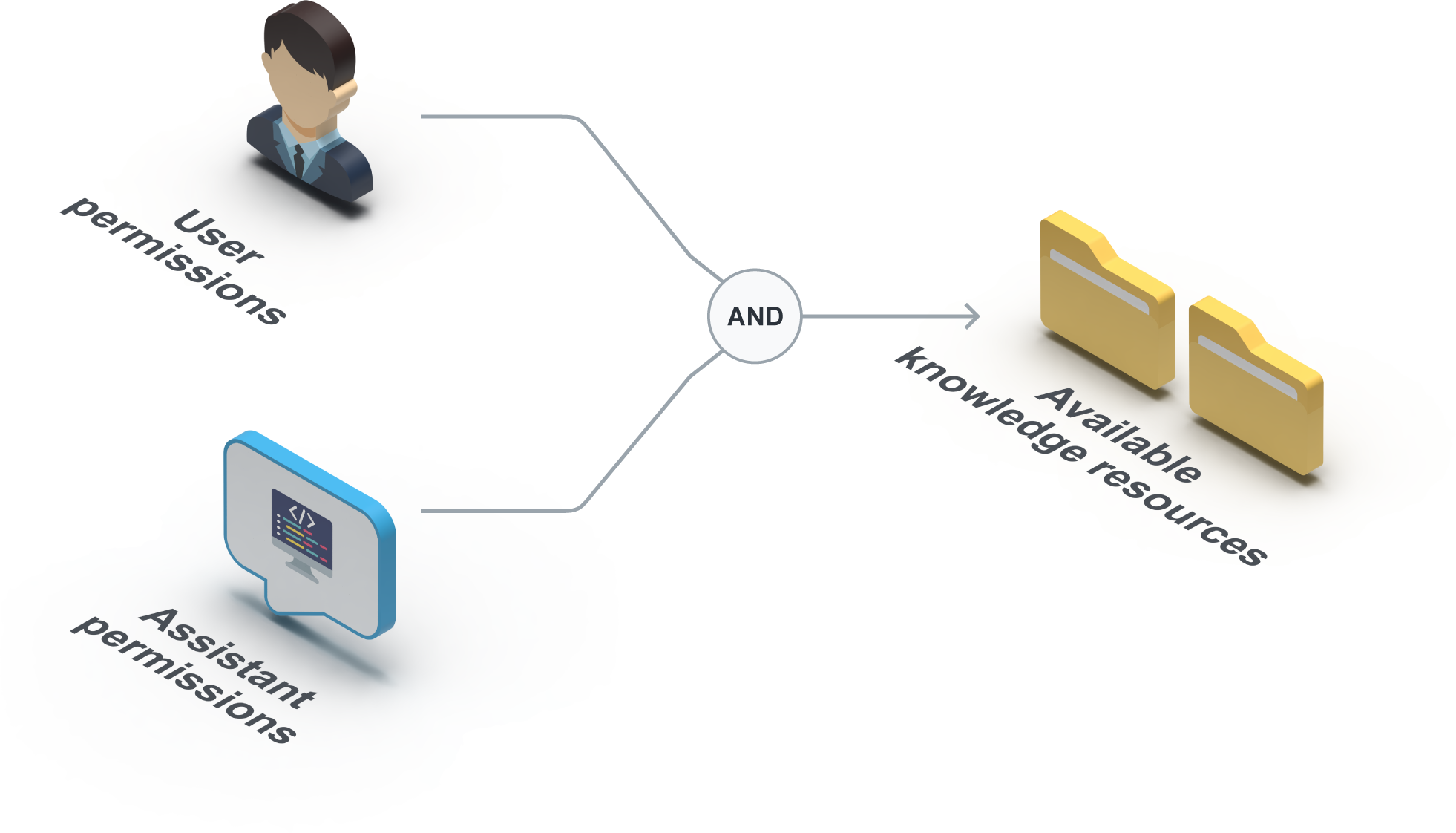
Not every document is intended for every employee or AI assistant. The IOWIS Platform therefore lets you organise knowledge into separate collections for teams, subject areas and tasks.
An assistant for technical questions can, for example, use different documents from an assistant for internal policies or HR matters.
Administrators specify:
- which users and groups can use a knowledge base,
- which knowledge resources an assistant can access,
- who can use or manage assistants,
- which data sources and workspaces are accessible.
Each request takes account of the user’s permissions and the configuration of the selected assistant. A language model does not automatically have access to all content on the platform.
Through single sign-on and LDAP, user and group management can connect to existing systems. How permissions from an external business application or file repository are carried over depends on the integration.
AI knowledge management
in day-to-day work
In addition to storing documents, the knowledge base makes the information they contain easier to access.
Employees can use an AI knowledge base to:
- resolve recurring internal questions on their own,
- bring together information from several documents,
- identify who is responsible, which requirements apply or what to do next,
- find documented solutions to similar problems,
- get up to speed with new tasks and subjects,
- access internal knowledge while away from the office or across different locations,
- use specialised assistants for individual departments or tasks.
The knowledge base is part of the IOWIS Platform. In the same environment, employees can also write and edit text, analyse documents, organise information and work with specialised assistants and agents.
Process company knowledge with AI in your own infrastructure
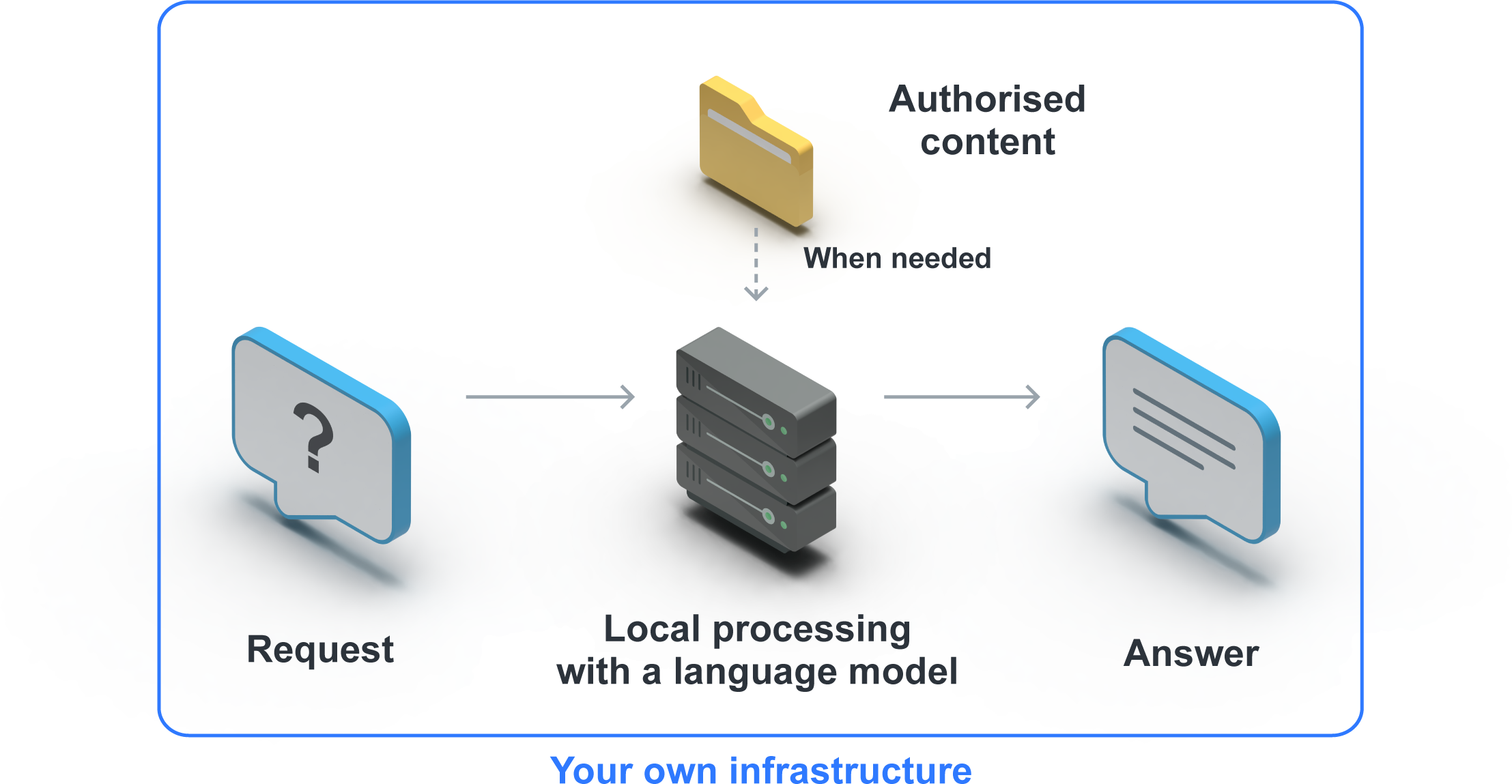
In a fully on-premises deployment, the IOWIS Platform runs in your company’s infrastructure on hardware selected for your requirements. The language models and core AI processing run there too.
Company content is not sent to external AI or model providers for processing. Searching the knowledge resources and generating the answer also take place within your environment.
External connections are set up only for features that actually need them. These might include a data source you choose to connect, a web search or another business system.
How beatmet24 makes internal knowledge accessible to nursing staff
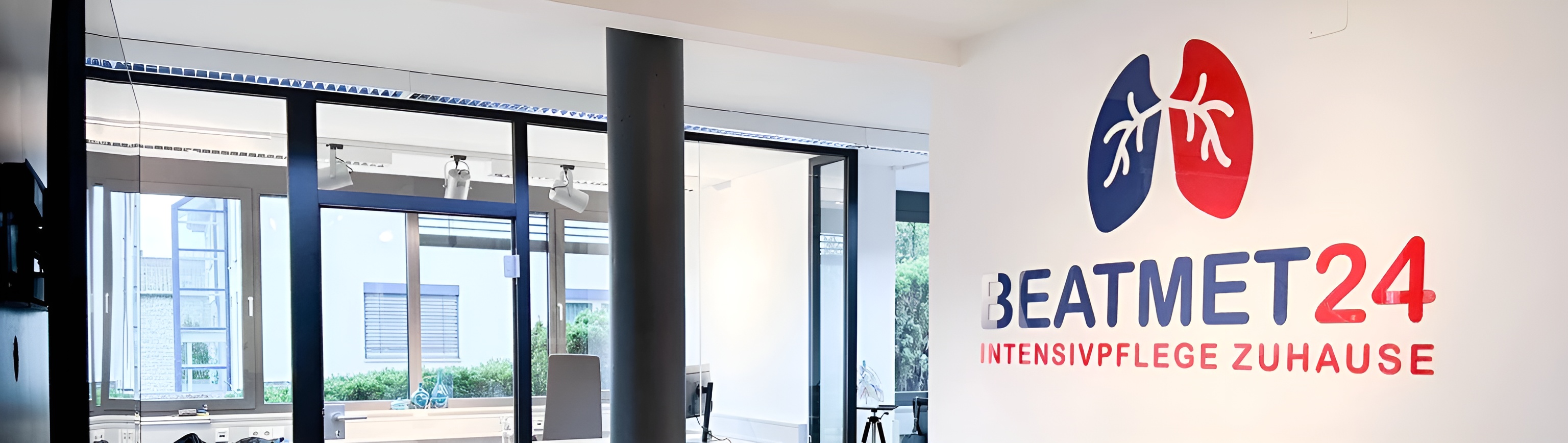
Photo: beatmet24 GmbH
Specialist home nursing provider beatmet24 uses the IOWIS on-premises AI platform to support around 300 nursing staff, along with office and administrative teams, with recurring internal questions.
Many of its nursing staff work away from the office and cannot always access documents held there or reach the relevant colleagues. The information they needed was often already documented, but had to be found manually or passed on in person each time.
Nursing staff access the platform through Microsoft Teams. The AI processing and work with internal knowledge take place on beatmet24’s own infrastructure. Office and administrative staff also use the IOWIS Platform’s central interface.
The connected content includes organisational documents, technical guidance, documentation for MEDIFOX care management software and sensitive HR documents. Fine-grained access permissions ensure that employees can only retrieve information intended for them.
For questions about internal information, the platform uses a RAG approach that restricts answers to the relevant sources. If those documents do not contain enough reliable information, the system does not generate an answer.
Make company knowledge
accessible with AI
In a demo, we show you how documents and knowledge sources can be used in the IOWIS Platform. We look at your intended use case, existing data sources, access requirements, on-premises IT environment and the right platform configuration.
Frequently asked questions about AI knowledge bases
Are documents and inputs used to train the AI?
No. Documents in knowledge bases, user inputs and generated answers are not used to train or fine-tune the language models in use.
Instead, documents are processed and indexed for retrieval. When a request is made, the platform finds relevant content in the knowledge resources the user is authorised to access and supplies it to the language model for that answer.
How is the knowledge base kept up to date when documents change?
New or changed documents are processed and indexed automatically. Changes in connected data sources are synchronised regularly. How synchronisation works and how often it takes place depend on the integration.
Administrators can also trigger synchronisation manually when needed.
When a document is deleted, the chunks, embeddings and vector database entries generated from it are also removed.
Are existing permissions carried over from connected systems?
If a connected system provides the relevant permission information, existing user, group and access permissions can be imported alongside the content and applied during retrieval.
How permissions are read and synchronised with changes in the source system depends on the integration. Access permissions can also be managed within the IOWIS Platform through its own roles and permissions system.