Sovereign AI
for businesses
Sovereign AI means that companies can decide for themselves how they use and run artificial intelligence. This includes control over where company data is processed and who can access it. Equally important is the ability to choose language models that suit their tasks and switch models when needed.
Choosing an AI solution also determines the conditions for its future use: how confidential information is processed, which features are available and how usage is billed. Changes made by the provider can disrupt established workflows or increase their costs to the point where they are no longer viable.
How cloud AI creates dependencies
Companies that have their data processed by a cloud AI provider can only implement their own requirements for storage locations, deletion schedules and access permissions to the extent that the provider’s technology and contract allow.
Another dependency arises when companies build their own software around the cloud provider’s AI features. Switching to another AI provider may then require parts of that software to be redeveloped.
The existing cloud provider can also force a company to modify its software. If the provider retires an AI version in use or changes its interface so that existing automations no longer work, the company has to respond. The provider sets the timetable. If the change catches the company unprepared, previously reliable workflows can fail. Tasks then have to be carried out manually for a time or left unfinished, while the technical work needed to resolve the problem adds further costs.
Dependence on one provider also leaves less room to respond to price increases. Changes to prices or the billing model can undermine the financial assumptions behind an existing AI deployment. If AI features previously included in a fixed fee are instead billed according to usage, the bill depends on how much text the AI processes and generates. Higher token prices can also make the same workflow substantially more expensive without improving its results. A previously cost-effective use of AI can become uneconomical. The company then has to absorb higher costs, limit usage or invest time and money in switching to another AI provider. Our blog post The cost is in the context (in German) explains how AI subscriptions are already moving towards usage-based billing and what this means for cost planning.
How on-premises AI keeps control within your company
Companies that want to depend less on a cloud provider’s operational and pricing decisions can run AI in their own infrastructure. In an on-premises deployment, language models are installed alongside the AI software on hardware within the company.
This allows AI to be integrated into the company’s own IT environment. Access permissions and deletion schedules can be configured to meet internal requirements, and external connections can be controlled through the company network. Confidential data can then be processed with AI without handing it over to a cloud AI provider.
The choice of AI models is no longer tied to the range offered by a single cloud provider. Companies can compare locally deployable language models from different developers using their own tasks, and select the models that suit their needs.

When AI runs locally, the company decides when to update the AI software or a language model in use. New software and model versions can first be tested with its own documents and applications. Before introducing an update, the company can check whether the AI performs the intended tasks reliably and whether existing automations still work.
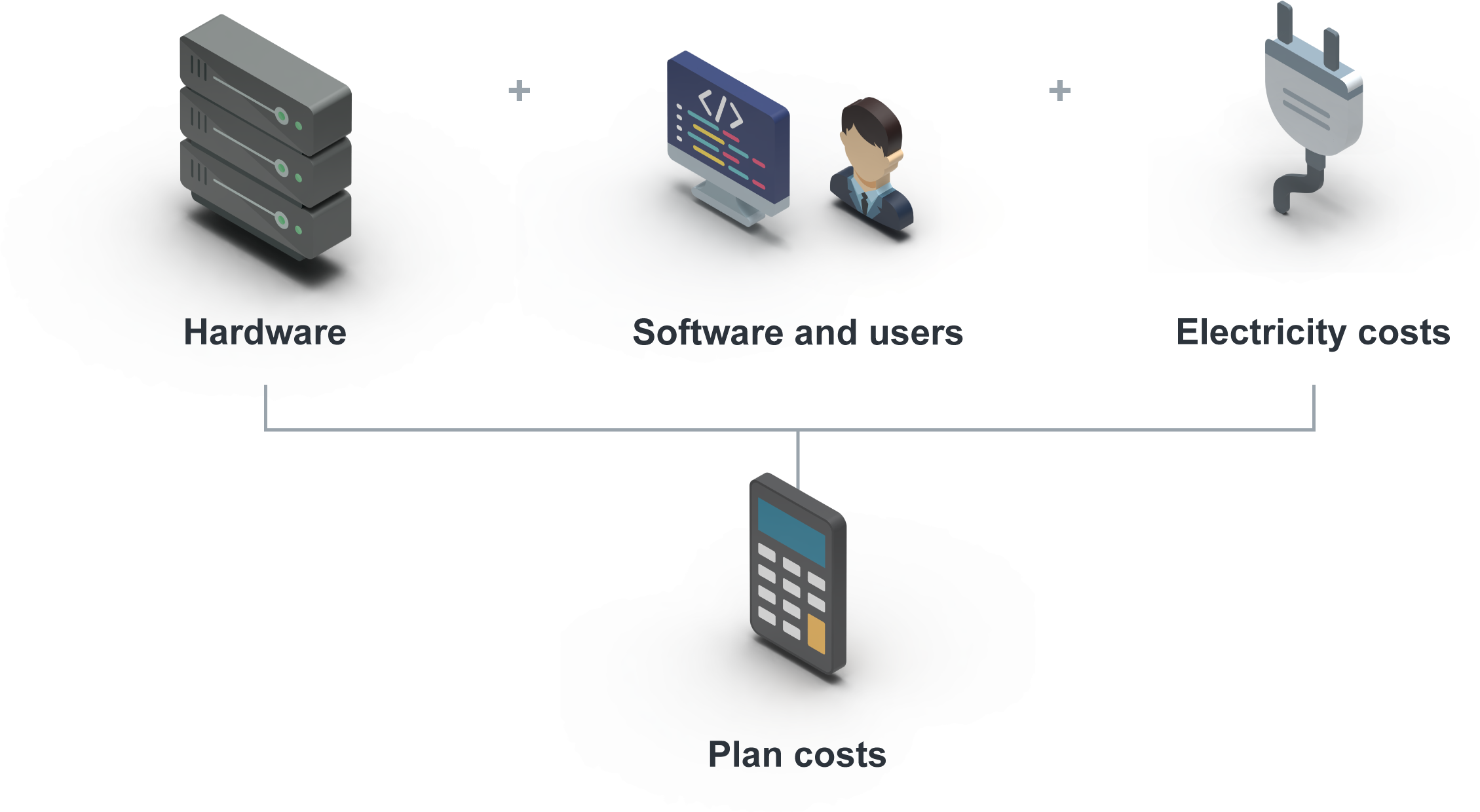
Plan AI costs independently of token prices
On-premises AI also makes costs more predictable. Instead of paying a cloud provider’s set price per million tokens, the company pays for its own computing capacity. Hardware is purchased or rented, and the costs of software and technical support are agreed. If the same hardware processes more AI requests, its purchase price or agreed fixed rental fee remains the same. Electricity costs can also be estimated in advance. Even for intensive AI use, the company can plan a budget based on its own operating costs rather than a cloud provider’s changing token prices.
Sovereign AI with the IOWIS Platform
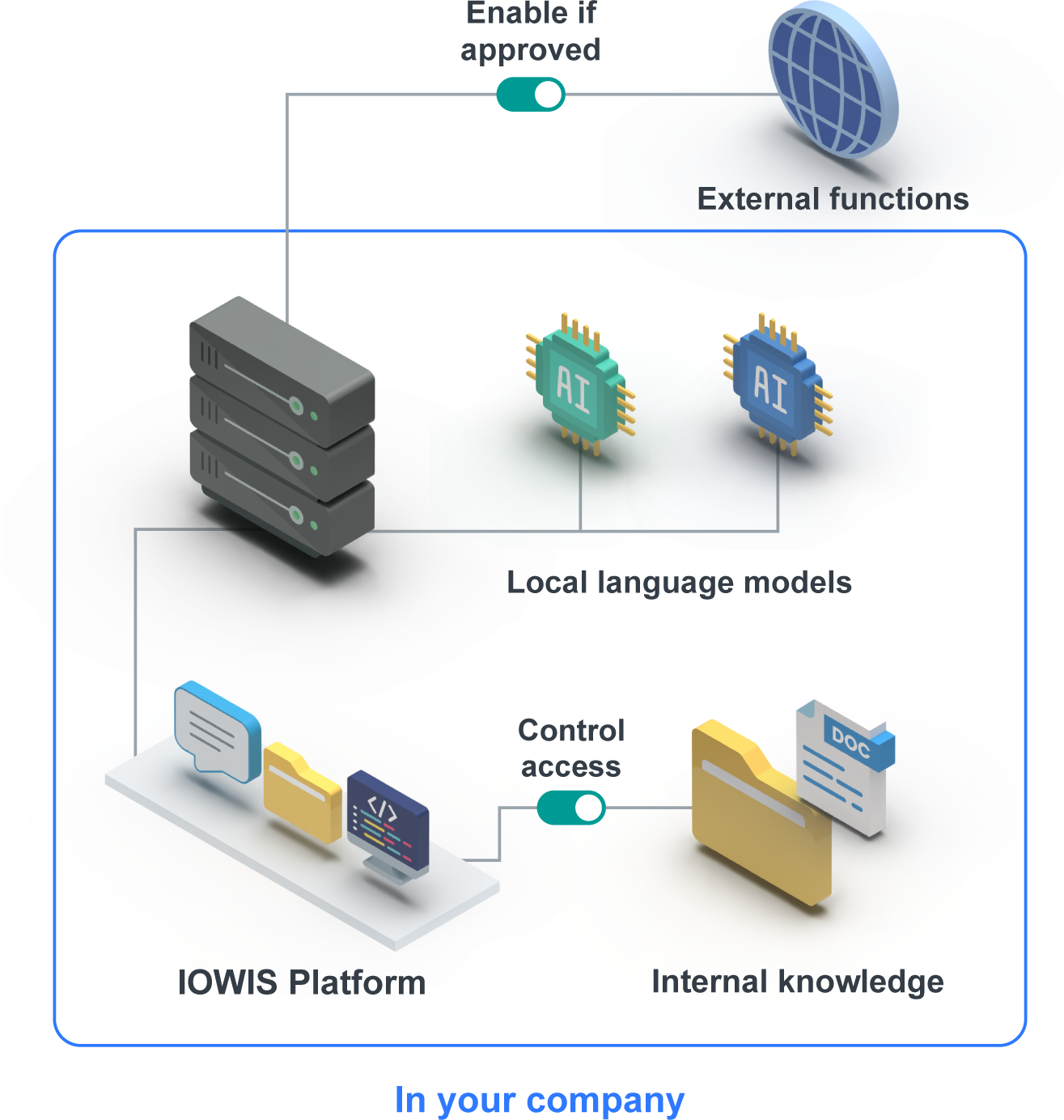
The IOWIS Platform is a complete on-premises AI solution combining software with hardware selected for your requirements. Your employees can use AI assistants, work with documents and access internal knowledge. IOWIS supports the technical implementation and provides ongoing support.
Your company data is processed locally. You determine which information the AI can use and who can access it through permissions for users, assistants, files and knowledge bases. The local AI features also work when fully disconnected from the internet. Additional online features, such as web search, are set up only if your company approves them.
The platform supports multiple locally deployed language models at the same time. IOWIS supplies models suited to your tasks and can also set up models you request. You can switch to another language model while your employees continue working in the same IOWIS Platform and familiar interface.
IOWIS supplies updates for the software and language models. You decide when to install them and can schedule them around your testing and maintenance windows.
IOWIS Platform software plans are priced per user per month. This means you calculate software costs based on user numbers and features, rather than the number of tokens processed. Software and model updates, along with support, are included. Hardware and setup are quoted separately; hardware can be purchased, rented or leased.
How does the IOWIS Platform fit your business?
In a demo, we show you how your employees can work with the platform and how you can manage assistants, knowledge and access permissions. Together, we discuss which features and hardware suit your intended use.
Frequently asked questions about sovereign AI
Is a server location in Germany or the EU enough for sovereign AI?
No. The server location alone does not tell you who controls AI processing, what access is possible, or who decides which models, updates and interfaces are used.
Sovereign AI also depends on whether a company can switch models and reuse its own data and configurations. What matters is the solution’s actual technical and contractual capabilities.
Can local AI models match the performance of leading cloud models?
No. For particularly demanding tasks, the most capable proprietary cloud models still achieve a level of quality that locally deployable models cannot fully match on cost-effective business hardware.
Many specific business tasks do not need that maximum capability, however. What matters is whether a model can perform the intended tasks reliably, quickly and to the required standard. A larger model or one with better benchmark scores is not automatically the better choice if its additional capabilities provide no clear benefit in actual use.
Open-weight models are developing rapidly and closing the gap in various areas. Benchmarks provide a useful guide, but only partly reflect practical use with your own documents, instructions and workflows.
IOWIS therefore selects models to suit the intended tasks, requirements for quality and speed, and available hardware.
Current model comparisons:
Does IOWIS have permanent access to the system or receive data from our environment?
No. IOWIS does not have remote administrative access to the platform by default. The platform also does not send telemetry, usage statistics, error reports or company content to IOWIS.
If IOWIS needs access to the system for a support request, you decide whether and how to provide it. One option is to enable remote access temporarily. An on-site visit can be arranged separately on request.
Can we export our data and configurations and reuse them outside the IOWIS Platform?
Yes. Your own documents, chat histories, assistant instructions and configurations can be exported from the IOWIS Platform. These contents are then available for reuse outside the platform.
How they can be transferred to another solution depends on its import capabilities and technical structure. Depending on the target system, the exported data may need to be converted or configurations adjusted.